

Interview with Dutch Interior
Interview with Davis Stewart and Noah Kurtz from Dutch Interior (for 95bFM)

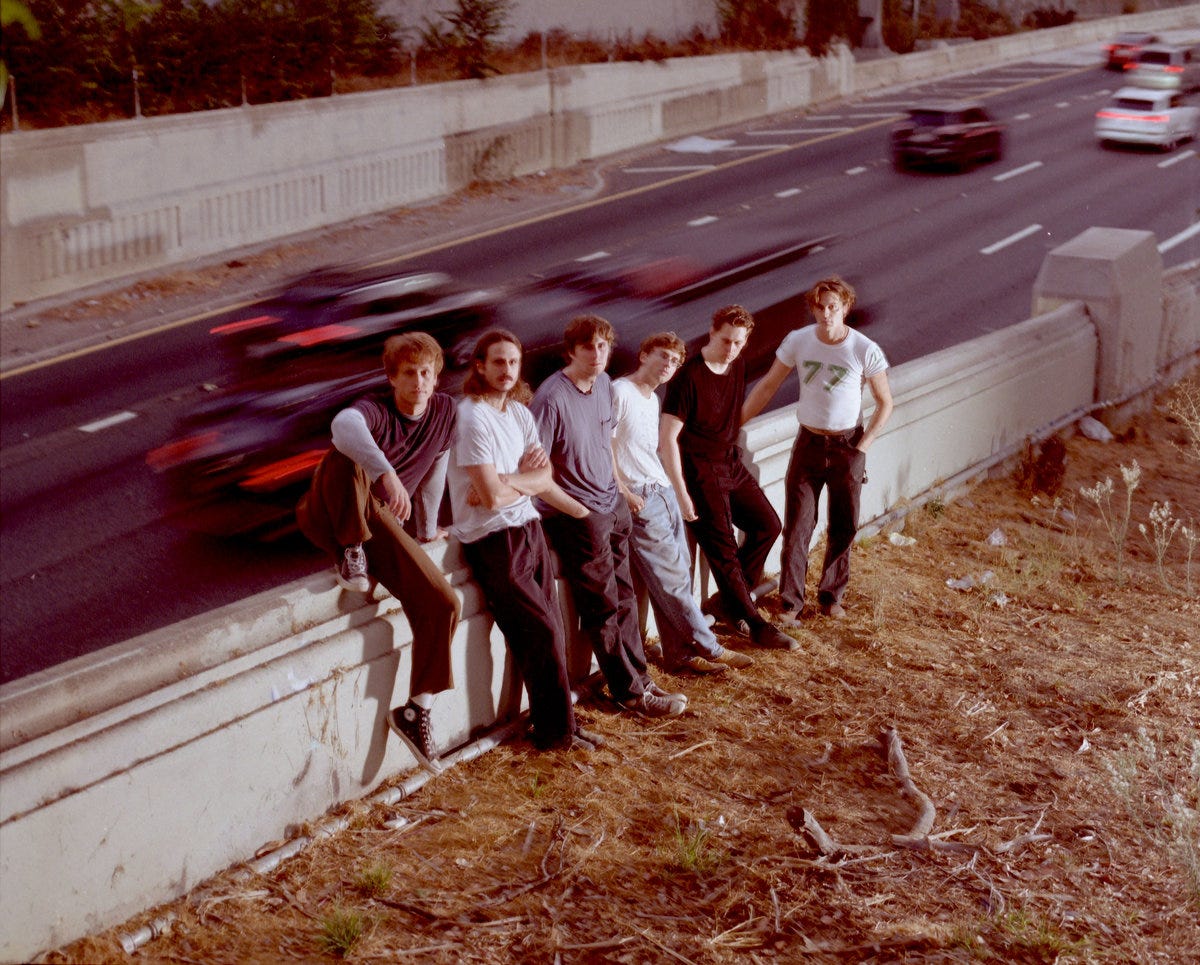


Lucia: How are you guys going today?
Davis: Good, good, yeah.
Noah: Not bad, not bad.
D: Just tired, still bouncing back, but we're good.
L: Yeah, pre band practice interview!
D: Yeah, mhmm. Good stuff. Good stuff.
L: It's quite hard to find stuff about you online, you know, it's all very fresh - I'm gonna give you the space to introduce yourselves. For the people who haven't heard your music yet or haven't heard about you, what would you like to tell them about yourselves?
N: Yeah. We're basically, we're an indie rock band from LA. We're a group of six lifelong friends who sort of collaborate on songwriting, in a maybe unique way. Each band member contributes their own songs and sings them, and then we work together in the studio to produce those songs and then bring them to life on stage, which is a really fun part of the progress. But, you know, our music ranges anywhere from country, folk, to noise, rock, experimental stuff like that. So that's kind of the overarching idea of the band and the heart of the band.
L: And then a lot of the stuff that is out there about you guys, the friendship is a huge element of what’s a driving factor behind the band but also as a listener, something that you pick up on, and you have said that you were all in bands together previously in various iterations. How did that kind of culminate into Dutch Interior?
D: The band started during Covid. Me and Noah and Jack, we were the members that were living together, and then my friend Conner too. He would come over, and we would kinda just - we had a tape machine in our living room, and our whole first record that's out is those sessions where we would just drink very heavily and then kinda just hit play on a record and just make songs for fun, and we ended up not really ever thinking we'd do anything with it. And then, like two years later, we just put it on Spotify just for fun and then didn't think about it for another six months. And then one of our friends texted us and was like, do you wanna play a house show?And we were like, sure. And then then we became a band. But before that, I mean, we've kinda always just been such good friends and always been musicians. So, like, we're gonna do it regardless. It just kinda took a more formal space, I guess…
N: Yeah. Music has been sort of the thread through each of our lives and friendships growing up. Davis and the drummer have known each other since they were babies, and me and the guitar player Conner met in fourth grade in guitar class. Our keyboard player, he’s brothers with our drummer, they’d been making music. [For] each of us, music was a major piece of our lives, and then us being friends, naturally we just were always making music together. And then I think Dutch Interior was sort of like the final iteration of that experience. Together for us as friends it was like, “Okay, we've all been doing this, making music. Let's do something and we kind of found its final form as Dutch Interior, which was really fun.
D: Yeah. It was really natural, though. There was no real - it was never like “Oh, us, we're a band, let's fucking do it. It kinda just happened that way.
N: It was the thing that made the most sense, in all of our lives.
L: As you just mentioned before, you were kind of like a happy accident, just playing around with tapes and drinking, and all of that good stuff. How was the experience of making Moneyball, moving to a more intentional, perhaps, creation method - how did the recall come to be?
N: Yeah, through all of the projects that we've done it's kind of just been, again, like a natural progression of “Alright. We did the living room tape machine on the floor project, where can we go next? Well, Shane's garage is open. Let's set it up there because we don’t want to do it in the living room again.” So now we're in a garage during the summer, and we're making - still on tape - Blinded By Fame. And yeah, just kind of the same thing, bringing our songs together, releasing that as the first project where, “Okay, this is kind of like a band thing… We're gonna put Blinded By Fame out.” And then after that, it was like “Okay, people kinda like this. What if we, you know, what's next? We're not gonna do it in the garage again, well, how about we get into a studio, like a proper studio?” So that's when we ended up finding a real space. Jack, who's in the band, has some construction knowledge, and so he sort of helped us build this proper sound-treated room in Long Beach, where we're sort of based out of. And then, Conner, who's been our producer - he's the one who brought the tape machine over, you know - so he kind of headed the studio side of things. And he's like, “Okay, well, let's get some good gear and start investing some more into this next record, which would become Moneyball.” It's intentional, and it's not intentional. It's just sort of, again, the natural progression thing, “Well, what if this record is, you know, maybe it's not on a tape machine this time? Let's do it on a computer but still use the same sort of heart and soul of our recording process and songwriting and production and all that.” And then, you know, we ended up signing a record deal halfway through, which helped out a lot too because then we can think about “Maybe we get someone else to mix it as opposed to mixing it ourselves.” We had a little bit of cash to work with, and then we called the album Moneyball because -
D: *laughing* Because they gave us money.
L: I saw that; I saw that you guys wanted to call it what the advance from the label was.
D: Yeah. They didn't they didn't think that was very funny.
L: I think that's hilarious. You should release the B sides and name it with what that was.
L: Through the singles that have been released so far, nostalgia is a prevalent theme. Are there other specific themes that you've been harnessing through your creative process, or do you wanna speak a bit on nostalgia itself?
D: Yeah. I think it's just like the prevalence of, like, decay in American culture. It's, it's very apparent through advertising and internet usage, and I think that nostalgia is a natural reaction to that. And I feel like a lot of media is being recycled back in our faces that's a little bit easier to consume. Do you wanna say anything? He’s smarter than me.
N: Yeah. I mean, as far as the themes the themes in the songwriting and the themes that we kind of present afterwards sort of, like the creative direction, which Davis is in charge of - he does all our music videos, all of our aesthetic, anything on the Internet or marketing, album covers, stuff like that - we sort of just kind of tie it into what naturally we're writing as a band at the time. So again, yeah, nostalgia is definitely a big point in this sort of sense of loneliness, despair - kind of like those classic, sad, music, songwriters.
D: Sad boy indie bullshit. Yeah.
N: But it's just like the natural things that we write about, but we don't really come in it with an intention. It's sort of just a screenshot of how we're all feeling in a six month period before we go to record the album. Blinded by Fame, I feel like, had a little more lighter themes for sure.
D: Yeah, this one’s a lot more fucking depressing.
N: Which is funny to see as a group of five songwriters and best friends. How the cohesion happens is so natural because we're, you know, the proximity to each other and our influences and our experiences in our lives. So it kinda just, like, falls on the table. It's like, “Okay, this is what we all wrote about.” And then Davis helps tie everything together. He's also written a song as well, but [he] sort of ties things together too with the ultimate creative direction of that album.
L: I guess this is just kind of [part of] being a semi-new artist, this happens. Often being compared to other musicians such as MJ Lenderman, you've compared a song of yourselves to Fleetwood Mac - you said it was like a depressing Fleetwood Mac song or something. Do you have specific influences that you guys are intentionally going after? I've also heard that you're a fan of School Fair, from New Zealand.
D: Yeah! Dee mixed Blinded by Fame for us, mastered it. So we've been back and forth in contact with them for a long - we were actually just talking about how the dream tour [for] us would be to play with them and stuff. But, yeah, we're huge fans of School Fair. It's very rare [that] we'd pull up a specific thing and be like, “We should make a song that sounds like this.” But through us hanging out so much - noise and drone and stuff is what I really like and a lot of ambience and noise rock music. And then my influences will have little little tidbits that shine their head because we'll all suggest things that aren't specifically in reference to that, but I'll be like, “Oh, what if we did a more distorted thing here or something of that nature?” And then Noah really likes a lot of country guitar, like Eagles-y, harmony based stuff.
N: Yeah. Stuff like that. We each kind of have our our zone in a sense of what genres or bands influence us, but there's so much crossover, it's hard to tell where it's coming from. Specific influences, I don't know, we've been talking about it so much and I feel like I can't think of one.
D: Like, Wilco, probably? We're just kinda ripping off Wilco for the most part. But it's a different thing, there's more songwriters and stuff like that, but they they use a wide range of rock to country to outsider music influence that I think captures sort of what we try to do as well. They also self produce a lot of their stuff.
L: It’s interesting seeing, especially at the moment with bands like Wednesday, seeing this weird crossover between noise and shoegaze and country.
N: Yeah, yeah.
D: Totally, definitely.
L: You said that you do all of the visual aspects of [Dutch Interior], and also, you're named after paintings.
D: Yes, yes.
L: What’s the importance of art direction behind a band's image? Your music videos are amazing; your album covers are beautiful - it's very clear that you've got a strong mind about visual arts as well. What's that pairing between the music and the visual arts like to play with?
D: It's a hundred percent just gut feeling. Like, I just know when something feels like Dutch Interior. I have been a person that's always thought very visually, when I hear stimulus I picture stuff. So when I think of stuff, I'll just listen to the songs over and over and just write whatever comes in my head, and that can go to different stuff. I also really like stealing, so I steal a lot. And I think that also works with the band itself too. I like hiding us in things that are already representative, it kinda adds this weird - our last tour flyer’s a Google Image. Like, I took Google images and copied all their fonts and everything and used their whole layout to make our tour flyer with our own images in it.
L: Oh, that's sick.
D: But I think it's really cool. It has nostalgia and familiarity. I don't know exactly how it plays, I just think it's important. I think a lot of bands don't put the effort into it as much, or just don't see the value in it. I think that it just goes to show types of people that don't value that, and that's okay. It's just something, personally, that's really important to me, and something that I find fascinating when taking someone from being a band I love, and I love their music to being like, “Oh, this is my favourite band of all fucking time.” Because all of these little things are considered, and it's like this perfect world that I can immerse myself into. And every little thing is considered rather than just, “Oh, here's a photo and photo that I put on my cover, or here's me with my guitar like this, you know,” *poses with a peace sign*. I just think that the output should be as quality as the music is.
L: You're so right about saying that that's kind of what pushes the band to the next level because you can immerse yourself into the world visually as well as sonically.
L: Well, it was just so lovely to chat to you guys. Is there anything else that you want to specifically put out into the world?
N: No. I mean, listen to Moneyball on Thursday or Friday, whenever it comes out.
D: Whenever the fuck it comes out.
L: Tomorrow, I think it comes out tomorrow.
D: Tomorrow at nine.
N: Oh, yeah, that's right.
D: I don't know, my head's been in the ground for so long. *laughs* I feel fucking crazy, I’m sorry.
N: We just played 16 shows at a music festival last week (South by South West). We just got back and played a show while we were driving home, where we stopped and did the show after [the festival]. It was it was chaotic.
D: Yeah. So everyone's either borderline sick or exhausted or just staring at the ceiling kind of vibe.